
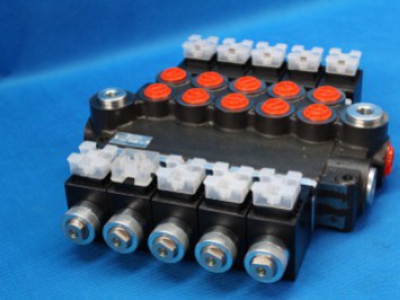
5 Spool Hydraulic Control Valves: Design, Operation, and Applications
A 5 spool hydraulic control valve is an essential component in hydraulic machinery, providing precise control over the flow of hydraulic fluid. These valves manage fluid flow to different paths from one or more sources, making them fundamental in operating complex machinery. The 5 spool hydraulic control valve consists of five individual spools housed in a cylindrical valve body, with each spool controlling specific flow paths.
Construction and Operation of 5 Spool Hydraulic Control Valves
The basic design of a 5 spool hydraulic control valve includes five spools that are either mechanically or electrically controlled. The movement of these spools directs hydraulic fluid flow within the valve body. The valve operates through lands and grooves, with the lands acting as barriers to block fluid flow and the grooves allowing the hydraulic fluid or gas to pass through and around the spools.
There are two primary positions for each spool in the valve:
- Normal Position: The valve returns to this position when the actuating force is removed, stopping the flow of hydraulic fluid.
- Working Position: The spool moves into this position when an actuating force is applied, allowing fluid to flow and perform the desired task.
Some 5 spool control valves feature three or more positions, including a spring-centered position. This design includes two working positions and a default normal position, allowing greater control over the fluid flow.
Specification of 5 Spool Hydraulic Control Valves
5 spool hydraulic control valves are typically specified by the number of ports and the number of switching positions, represented as np/ns, where:
- np: Refers to the number of ports connected to the valve.
- ns: Refers to the number of switching positions the valve has.
For instance, a valve described as 4-way, 3-position (or 4/3 Control Valve) has four ports and three switching positions. In this setup:
- The pressure port connects to the hydraulic pump.
- The tank port connects to the hydraulic reservoir or tank.
- The two working ports connect to actuators like hydraulic cylinders or motors.
Before selecting a valve, other factors such as the type of fluid, its viscosity, and the operating temperature must be considered to ensure optimal performance.
Actuation Methods for 5 Spool Hydraulic Control Valves
5 spool hydraulic control valves can be operated through various methods, providing flexibility based on the system's design and operational needs. These methods include:
- Manual Operation: Manually operated valves are controlled using levers or paddles, allowing the operator to physically move the spools to control fluid flow. In some systems, a spring mechanism returns the spools to their normal position once the control lever is released.
- Electrical Operation: Electrically operated 5 spool valves utilize electromechanical solenoids to shift the spools. When electrical power is applied, the spools move to direct the fluid flow. These valves are commonly used because of their ease of control, but electrically operated solenoids can have limitations when large forces are required. Overuse of these solenoids can cause heat buildup, limiting their continuous duty cycle.
- Pneumatic and Hydraulic Operation: In systems that require higher force, pneumatic or hydraulic actuation is used. Often, a low-power solenoid (known as the pilot valve) controls the flow of fluid to a larger hydraulic valve that requires greater force. This method provides efficient fluid control with minimal energy consumption.
Applications of 5 Spool Hydraulic Control Valves
Due to their ability to control multiple fluid paths, 5 spool hydraulic control valves are widely used across various industries, including:
- Construction Equipment: These valves are integral to the hydraulic systems in cranes, excavators, loaders, and other heavy machinery, controlling multiple hydraulic functions simultaneously, such as lifting, tilting, or extending parts.
- Agricultural Machinery: In tractors and other agricultural equipment, these valves regulate hydraulic systems that operate plows, sprayers, and other implements.
- Industrial Automation: In industrial systems, 5 spool valves are used to manage hydraulic actuators that perform tasks like clamping, lifting, and positioning components.
Conclusion
The 5 spool hydraulic control valve is a versatile and essential component for complex hydraulic systems. Its ability to control fluid flow across multiple paths makes it ideal for applications requiring precise and flexible hydraulic operations. Whether manually, electrically, or pneumatically actuated, 5 spool valves ensure smooth and efficient machine operation across various industries, from construction to industrial automation.
Photo Gallery
-Photoroom.jpg)
-Photoroom.jpg)
Do you need help?

Contact with us today!
We will help you select right kit. Contact us today at shop@hydraulic-master.com