
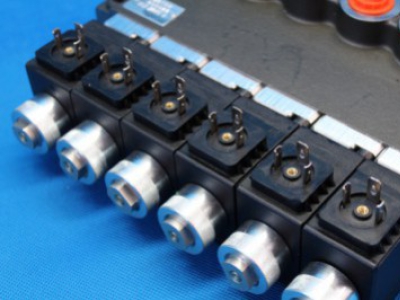
Directional Control Valves: Design, Operation, and Applications
The directional control valve is a critical component in hydraulic systems, responsible for directing fluid flow along different paths from one or more sources. These valves play a key role in managing the movement of hydraulic fluid, enabling precise control over mechanical operations in a wide range of industries.
Construction and Operation of Directional Control Valves
A directional control valve consists of a spool inside a cylindrical valve body. The spool's movement, which can be controlled mechanically or electrically, determines how fluid flows through the valve. The design of the spool includes lands and grooves:
- Lands: These block the flow of hydraulic fluid.
- Grooves: These allow fluid to flow around the spool and through the valve body.
There are typically two fundamental positions for a directional control valve:
- Normal Position: The valve returns to this default position when no actuating force is applied, stopping or redirecting the flow of fluid.
- Working Position: The valve moves to this position when actuating force is applied, allowing fluid to flow and perform a specific task, such as moving a hydraulic actuator.
Some directional control valves also feature a spring-centered position, where the valve has two working positions and a central neutral position, allowing for more precise control.
Valve Specification and Terminology
Directional control valves are specified using two key factors: the number of ports (connections) and the number of switching positions. This is typically represented as np/ns, where:
- np: Number of ports connected to the valve.
- ns: Number of switching positions the valve can move into.
For example, a valve described as a 4-way, 3-position (or 4/3 directional control valve) has four ports and three switching positions. In this configuration:
- The pressure port connects to the hydraulic pump.
- The tank port connects to the hydraulic reservoir or tank.
- The two remaining working ports connect to actuators like hydraulic cylinders or motors.
Apart from the valve's configuration, factors such as the type of hydraulic fluid, operating temperature, and fluid viscosity must be considered when selecting the right directional control valve for an application.
Methods of Actuation for Directional Control Valves
Directional control valves can be operated by a variety of methods, making them versatile components in hydraulic systems. The most common methods of actuation include:
- Manual Operation: Manually operated valves use levers or paddles to shift the spool. The operator applies direct force to control the valve's position, which directs fluid flow. In many cases, springs are used to return the valve to its neutral position when the control lever is released.
- Electrical Operation: Electrically operated valves use electromechanical solenoids to move the spool. Applying electrical power moves the spool to the desired position, allowing fluid to flow. While electrical operation is convenient and precise, solenoids have limited force output and can generate heat during extended use, restricting their duty cycle in high-force applications.
- Pneumatic and Hydraulic Operation: When more force is required, pneumatic or hydraulic actuation is used. In many cases, a low-power solenoid is used as a pilot valve to control a larger hydraulic valve, ensuring efficient operation with minimal energy consumption.
Applications of Directional Control Valves
Due to their ability to precisely control the flow of hydraulic fluid, directional control valves are used in a wide range of industries and applications:
- Construction Equipment: In machinery such as excavators, cranes, and loaders, these valves direct hydraulic fluid to actuators, enabling movements like lifting, rotating, or extending components.
- Manufacturing and Automation: Directional control valves are used to control hydraulic presses, clamps, and lifts, ensuring smooth and precise operation in industrial systems.
- Agricultural Machinery: Tractors, loaders, and other agricultural machines rely on these valves to control hydraulic functions like raising and lowering attachments or operating hydraulic arms.
Manual vs. Electric Control in Directional Control Valves
The choice between manual and electric control depends on the specific application and the level of precision required. Manually operated valves provide straightforward control, ideal for situations where the operator needs hands-on engagement with the system. Springs are often added to return the valve to its neutral position, ensuring safety and ease of operation.
Electrically operated valves offer more precise control and can be integrated into automated systems. However, these valves are limited in terms of the force they can generate without large amounts of electrical power. Prolonged electrical use can cause heat buildup, so these valves are best suited for systems with lower force requirements or those that operate intermittently.
In systems requiring both high force and precision, pilot-operated valves are often used. In this configuration, a small electric or pneumatic valve controls a larger hydraulic valve, enabling efficient operation without the need for high electrical power.
Conclusion
The directional control valve is a versatile and essential component in hydraulic systems, allowing precise control of fluid flow in a variety of applications. Whether operated manually, electrically, or through pneumatic or hydraulic means, these valves are crucial in industries ranging from construction and manufacturing to agriculture. Their ability to manage multiple fluid paths and positions makes them an indispensable part of modern hydraulic machinery.
Photo Gallery
-Photoroom.jpg)
-Photoroom.jpg)
-Photoroom.jpg)
-Photoroom.jpg)
Do you need help?

Contact with us today!
We will help you select right kit. Contact us today at shop@hydraulic-master.com