Construction and Function of Hydraulic Joystick Valves
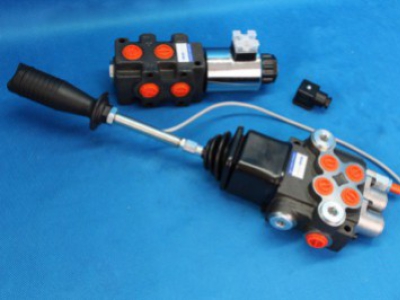
The hydraulic joystick valve operates on principles similar to those of a standard directional hydraulic valve. It consists of a sealed tube with two ports and an internal piston:
- First Port: This port connects to a hydraulic hose that delivers pressurized oil from the pump to the piston. The movement of the piston is powered by this hydraulic pressure.
- Second Port: This port connects to another hose that transports the hydraulic fluid from the valve to a hydraulic cylinder, propelling the cylinder’s movement.
The valve can be configured for use in open or closed circulation systems, depending on the application. In addition, hydraulic joystick valves can be connected to one another in a series, forming multi-section valves. These multi-section configurations allow operators to control multiple hydraulic functions simultaneously, each section having its own joystick.
Operation and Control
The hydraulic joystick valve is primarily operated using a manual lever. The joystick’s movements control the direction and flow of hydraulic oil through the valve, allowing the operator to perform specific tasks based on the lever’s position.
Most hydraulic joystick valves have three standard positions:
- Neutral Position: When the lever is in the vertical position, the hydraulic fluid is sent to the overflow, and the piston remains stationary.
- Work Position (Extend): Moving the lever forward causes the piston to extend, pushing the hydraulic cylinder into action.
- Work Position (Retract): Pulling the lever backward causes the piston to retract, returning the hydraulic cylinder to its original position.
In some configurations, two-position levers are used for simpler operations, while more advanced setups include spring-loaded levers that automatically return to the neutral position when released. This spring mechanism is commonly employed to improve safety and ease of use, ensuring that the valve stops moving when the operator is not actively controlling it.
For more complex control requirements, hydraulic joystick valves can also be combined with electric controls such as solenoids or servomotors, which move the piston into the desired position. This allows for greater flexibility, as the operator can switch between manual and electric control depending on the task.
Multi-Section Hydraulic Joystick Valves
In many industrial applications, multiple hydraulic joystick valves are combined into multi-section valve blocks. Each section of the valve block controls a different hydraulic function, allowing for multiple operations to be carried out simultaneously. For example, in a forklift or crane, one section might control the lifting mechanism while another section controls the tilt or rotation.
These multi-section systems are highly customizable, with joystick controls for each section, enabling complex hydraulic tasks to be performed with precision.
Key Specifications of Hydraulic Joystick Valves
The performance of a hydraulic joystick valve is determined by several key parameters:
- Piston and Thread Diameters: The size of the piston and thread connections affects the valve’s compatibility with different hydraulic systems and the volume of fluid that can pass through.
- Flow Efficiency: Measured in liters per minute (LPM), this specification indicates how much hydraulic fluid the valve can handle during operation.
- Maximum Pressure: The valve’s maximum pressure rating defines how much pressure it can withstand without failure or damage.
These parameters are critical when selecting a hydraulic joystick valve for a specific application, ensuring that the valve can handle the required workload.
Operating Conditions
Hydraulic joystick valves are designed to function in extreme environments, making them suitable for demanding industrial applications. These valves can operate in ambient temperatures ranging from -40°C to +60°C, and the oil temperature should be maintained between -15°C and +80°C to ensure optimal performance. The type of hydraulic oil required for the valve depends on the manufacturer’s specifications and the valve’s design.
Applications of Hydraulic Joystick Valves
Hydraulic joystick valves are widely used in industries where precision and control over hydraulic systems are essential. Common applications include:
- Forklifts: Hydraulic joystick valves control the lifting and lowering mechanisms, as well as the tilt of the forks, ensuring smooth material handling.
- Cranes: These valves manage the hydraulic functions responsible for lifting and rotating the crane’s boom, allowing for precise load positioning.
- Diggers and Excavators: In these machines, hydraulic joystick valves control the arm and bucket movements, providing operators with fine control over digging operations.
- Trolley Trucks and Planes: Hydraulic systems in vehicles and aircraft also rely on joystick valves for controlling various hydraulic actuators, ensuring accurate and safe operation.
Conclusion
The hydraulic joystick valve is a fundamental component in the operation of many hydraulic systems. With its combination of manual and electric control options, as well as its adaptability in multi-section configurations, the hydraulic joystick valve offers flexibility, precision, and ease of use across a wide range of applications. From forklifts and cranes to diggers and planes, these valves ensure smooth, efficient, and reliable operation, making them a valuable tool in both industrial and transportation sectors. With the right specifications and setup, hydraulic joystick valves are indispensable for ensuring safe and precise control of hydraulic machinery.